HRYC
Yarn Review: Zealana Kiwi Fingering
It's that time again! We go through the hardship of knitting with a particular yarn, and share our thoughts with you!

Zealana Kiwi Fingering
40% merino | 30% possum | 30% organic cotton
Structure: two ply, with each ply made up 4 x 2 ply singles
Weight: 4ply / fingering
Presented in: 40g / 124m balls
Recommended needle size: 3mm
Colour: Fern 07
Disclaimer: I started this review already loving this yarn, so there is a substantial bias present.
First things first: Kiwi Fingering is a little different to its sibling, the lace weight. It has a much more ropey appearance than the lighter weight, with a very distinct twist. Lovely and rounded, it makes for a bouncy fabric. The twist doesn't make for a nubbly look, though, it all smooths out for a nice even surface.

The cotton content gives an interesting difference in feel to the rest of Zealana range - it adds a robustness that makes it wear a little harder than those with predominantly wool content. But the cotton, oh the cotton! While it may be a surprising thing to throw in the mix with merino and possum fibres, it works brilliantly. It helps contain the fluffy possum-ness so it doesn't get quite so lofty over time. It also breathes when the weather is a bit warmer, so you can continue wearing it through the summer months as well as in winter.

I honestly don't think you can get any better when it comes to a 4ply yarn. It has everything: excellent stitch definition, great drape, it feels amazing, and it wears well. I used a 3.75mm needle for my swatch, and it makes my heart sing at the looser gauge. While it is labelled a 4ply, it tends to the heavier side and could even be substituted in projects calling for sport weight yarn (be sure to swatch!).
One thing I do recommend: rewind your balls before you start work. Kiwi is notorious for falling out of the ball it is presented in, and turning into a horrific tangle. So rewind by hand (or with a ball winder) to save yourself some stress later.

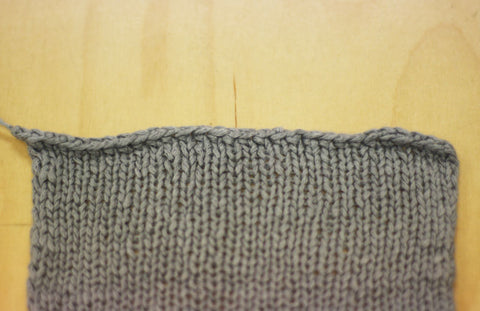
Spot the little stitches that are sitting higher than their counterparts above and below.
If you look closely at the swatch, you can see something odd happening in the middle. I was knitting it at Knit Night and got bored (as you do, I was having a serious lack of focus that evening) and passed it on to Hannah, one of our regulars, to have a go. Which turned up something fascinating - it shows really clearly how Hannah's tension is different between the right and wrong side. Even after blocking, the slight difference in stitch size is still there.

So, how to figure out if this is something that affects you? Do up a gauge swatch using a yarn with good stitch definition (like Zealana Kiwi). Start off with two needles the same size, and see if it works out to be even. You're looking for little ridges between the rows, to see if your knit and purl stitches come out different sizes. If they do, play around with a smaller or bigger needle size for the needle which does all the work on the wrong side.
Obviously this isn't a problem with knitting in the round, as you're always knitting on the outside. I have had some conversations recently with people who have discovered their gauge changes between knitting in the round and then switching to do magic loop or use double pointed needles. It's really worth taking the time to sit down and figure out if you are one of those knitters - it'll make a small but important difference in your finished objects.
To follow: Shelley's review, an interview (and giveaway!) with Mary-Anne Mace, and some pattern suggestions. Hooray!
Win some Knitsch Sock!
Amidst the busy-ness of the end of year, Knitsch Yarns is now officially on sabbatical. (don't fret if you are one of the two or three people waiting on yarn, it will happen in my one last dye day that is lined up). If you want to nab any of the last few skeins, you have two options: pop by the Petone store (there is a handful of sock and worsted on the shelves). Or, enter a competition!

Some of these colours may or may not be in the prize pack. It's a mystery!
There's a slowly growing pile of Knitsch that needs a new home - some beautiful seconds, some original skeins from right back when I first started dyeing. A real spectrum of the five years that has been the Knitsch journey so far. They are all being added to a paper bag, a bag that may end up with you.
How to enter? Just comment on this post! That's it. Make sure you do so by 5pm Monday 24 November, and i'll draw a winner on Tuesday morning.
I want to say thank you for all the Knitsch love - it really means a lot. And I want to emphasise that this certainly isn't the end of Knitsch - oh no! I'm already thinking about what new yarn bases I might like to add to the range, how to change our processes and how to better keep up with demand when Knitsch returns late next year. I will also be selling Knitsch Sock at Unwind in March, and Knit August Nights in August. So you won't have to go entirely without.
xx Tash
Christmas Party: the specials!
Hooray! We are super duper excited about the Christmas Party in Petone, and hope you are, too!
One of the most exciting things is we have a drinks sponsor on board - the excellent folks at Good Buzz Brewing have dropped off a bunch of their most delicious kombucha! I'm taste testing the Feijoa flavour and my goodness that is some tasty fizz. Added bonus: it has a whole bunch of stuff that's good for you in it.

And what you're all waiting for: the specials!
10% off all Knit Pro
Artisan Seconds for $10 each (usually $17)
15% off any Ashford wheel or loom purchase made on the day
15% off Zealana Air Chunky
15% off all Ashford Tekapo, Naturally Haven and Mythral
20% off all Spud & Chloe Outer
20% off Stitch Seekers books
20% off all buttons (excludes Buttons by Benji)
50% off Creating Original Hand knitted Lace books & Artisan patterns
And there will be a bunch of kits - DIY felt ball garlands, along with kits to make Dream Mitts, Flat Hats, Starfruit hats and Artisan Lace scarves all at special prices.
Every purchase will receive a goody bag, and I must say they are looking pretty ace (and tasty). Need the details again?

Don't forget, pop around the corner to The Sewing Depot - they will have some really amazing deals for the day, too!

Yarn Review: Shelley's Quince & Co Kestrel
I had to laugh when Shelley sent her review, below, through. We had a fairly quick conversation about needle size when we started with the Kestrel, and several comments followed about Shelley's....shall we say, regret, about choosing 4.5mm needles. We had rather different experiences with knitting this yarn, although it seems to have won Shelley over in the end. Which just goes to show how important needle size is in relation to your yarn choices.
Now, Shelley:
Quince & Co Kestrel
Swatch knitted on 4.5mm needles (recommended needle size is 5 – 6.5mm)
Tension: 4” square = 17 stitches x 28 rows
(washed and vigorously blocked several times before a wash and relaxed block).
I love knitting with linen. I adore the drape and sheen and that it get softer with every wear. So I was mildly excited about swatching the Kestrel. My issue with it turned out to be the tape ply construction. Granted, the recommended needle size is on the larger side, the tape should sit flat and create a lovely, drape and smooth stitch definition in the fabric.

I’m always fascinated to see how the heavier yarns knit up on smaller needles. I want to see how dense the fabric is, and how its definition changes (if at all). So for this sample, I decided to knit it up on 4.5mm needles. Not too much smaller than the recommended 5, but with the patterns on Ravelry recommending closer to a 6 or 6.5mm needle, I thought I could get honesty out of this one. And I did.
You need to be careful if your needles are a little on the sharp end, because you will snag the tape ply. It was a little crunchy to knit with, but linen always is, and there wasn’t much in the way of drape (being knitted on smaller needles, I didn’t expect there to be). The fabric on the smaller needle is substantial. Tape, however, not being plied, did twist quite a bit and created unevenness in the stitch definition.
So I decided on some washing and brutal blocking. I washed the swatch several times – both on a normal cycle and wool wash. Every time I put a load on, the swatch went in. Follow by a severe blocking and a steam-set. This settled the stitched into something more uniform, and softened it up. I washed it again, let it dry, and gave it a gentle set with the iron, for the measurements above. Putting it through the wash several times has done wonders for the drape and the feel of the fabric. I don’t have a drier at home, but I suspect that it would really come into its own after a tumble through the machine.
Having grumbled through knitting the Kestrel on smaller needles [and she really did grumble – tash], I started to really appreciate it after the washing and blocking.
I would consider it for cardigans or heavy t-shirt sort of patterns, such as:
Jane Richmond’s Gemini out of the Knitty Spring + Summer 2012 (watch the tension, but this could totally work);
or Olga Buraya-Kefelian’s Francis (written for 10ply silk, but again, would be elegant in linen);
Beautia Dew’s Petrie out of the Knitty Spring + Summer 2010 for an retro boat neck top,
or Louisa Harding’s Miss Kitty (although there are sizing limitations).

My outside favourite, and something I would consider knitting in Kestrel, is actually Jennifer Miller’s Pixie Vest (above) – the pattern is simple and flattering, and the linen would suit the stitch definition without growth being a problem.
My swatch has taken a beating, and it still looks good. I’m quite impressed with it.
Pattern ideas: Quince & Co Kestrel
Following our yarn review of Quince & Co Kestrel yesterday, here's a few ideas of what to make with a bit of the luscious linen:


Tolt Folded Bag by Veronika Jobe


